The Massive FY26 Limit Increase
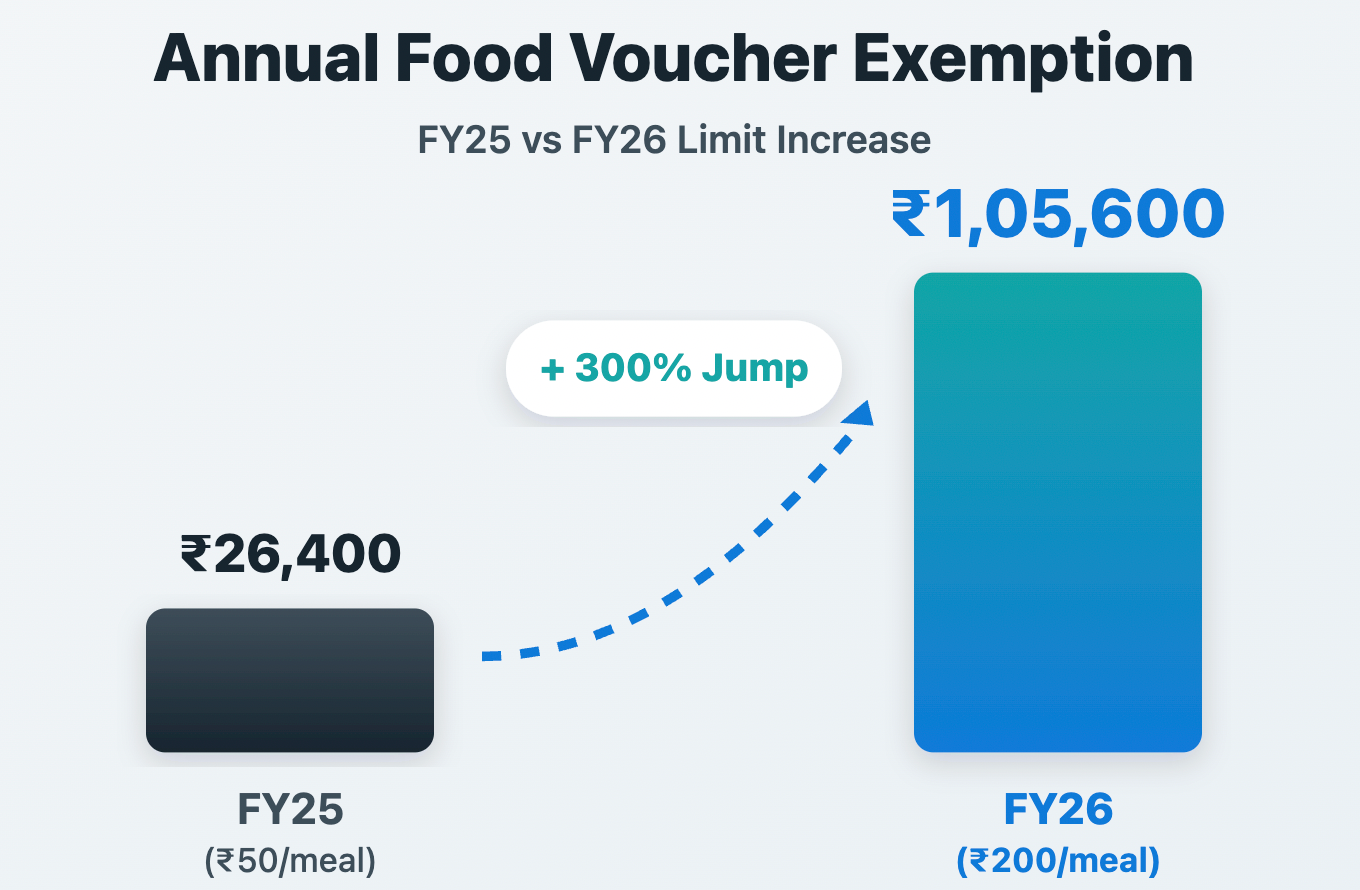
In a game-changing move for salaried employees, the April 1st regulations have completely overhauled the food voucher exemption under Rule 3(7)(iii). Not only is this exemption now available in the New Tax Regime, but the archaic ₹50 per meal limit has been quadrupled to ₹200 per meal.
The New ₹1 Lakh Exemption Math
The calculation for this tax-free allowance is straightforward but incredibly lucrative. Assuming an average of 2 meals provided during working hours over 22 working days in a month, the math looks like this:
• Per Meal: ₹200
• Daily Total (2 meals): ₹400
• Monthly Total (22 days): ₹8,800
• Annual Tax-Free Allowance: ₹1,05,600
By restructuring your salary to include this maximum allowance, you can instantly shield over ₹1 Lakh of your income from taxes every year.
FY25 vs FY26: The Ultimate Comparison
To understand how big this update is, let's compare the rules and maximum tax savings between the previous financial year (FY25) and the current one (FY26). The table below clearly shows how the New Tax Regime is now the undisputed winner for meal allowances.
Tax Savings in the 20% Slab
For middle-income earners falling into the 20% tax bracket under the New Tax Regime, routing ₹1,05,600 through meal cards instead of accepting it as taxable cash yields massive savings.
• Taxable Income Shielded: ₹1,05,600
• Tax Rate Avoided: 20% + 4% Health & Education Cess (20.8% total)
• Net Annual Tax Saved: ₹21,964
Instead of giving almost ₹22,000 to the taxman, that money stays in your pocket, effectively paying for a couple of months of your grocery bills.
Tax Savings in the 30% Slab
For high-earning professionals in the 30% tax bracket, this is arguably the easiest and most liquid tax-saving instrument available today, outperforming many traditional 80C investments because it requires zero lock-in period.
• Taxable Income Shielded: ₹1,05,600
• Tax Rate Avoided: 30% + 4% Health & Education Cess (31.2% total)
• Net Annual Tax Saved: ₹32,947
By making a simple request to HR, you save nearly ₹33,000 annually. This is money you were going to spend on food and groceries anyway, now completely tax-free.
How to Claim Your ₹1 Lakh Allowance
Unlike HRA (which requires rent receipts) or LTA (which requires travel bills), claiming the meal allowance is virtually frictionless. It is not an investment; it is a salary restructure. You simply need to ask your payroll department to allocate ₹8,800 per month as a Food/Meal Allowance. This amount is then credited to a prepaid digital card (like Sodexo/Pluxee, Ticket Restaurant, or Zaggle) which is universally accepted at supermarkets, local kiranas, and food delivery apps like Zomato and Swiggy.