
Home Loan Prepayment vs. Mutual Funds in India: The 2026 Guide to Smart Investing
For many homeowners in India, a common and critical financial question arises:
Should I prepay my home loan, or invest my extra savings every month?
The right answer isn't universal; it hinges on three key factors:
- Your loan's interest rate.
- Your expected investment returns.
- Your personal comfort with risk.
To give you a clear and practical understanding, let's explore this dilemma with a realistic example scenario.
Example Scenario: The ₹50 Lakh Dilemma
Let's assume you have the following finances:
- Loan Amount: ₹50 Lakh
- Interest Rate: 9.5%
- Loan Tenure: 20 Years
- Monthly EMI: ₹46,600
- Extra Monthly Savings: ₹20,000
You now have a crucial choice to make with that extra ₹20,000:
- Prepay the Loan: Increase your EMI and become debt-free sooner.
- Invest in Equity Mutual Funds: Aim for higher growth through stock markets.
- Invest in Gold Mutual Funds: Seek stability with a traditional safe-haven.
Let’s dive deep into each option.
Option 1: The Power of Home Loan Prepayment
What happens if you use that extra ₹20,000 to increase your monthly payment?
- New Monthly Payment: ₹66,600
- Tenure Reduction: Your loan is paid off in approximately 10 years, down from 20.
- Total Interest Saved: You avoid paying a staggering ~₹38 Lakh in interest.
Why This is a Great Strategy
Choosing prepayment is equivalent to earning a guaranteed, tax-free return of 9.5%. This is because every rupee you prepay saves you the interest you would have otherwise paid to the bank.
Benefits:
- Guaranteed Return: You know exactly how much you're saving.
- Zero Market Risk: Unaffected by stock market ups and downs.
- Debt-Free Faster: The psychological relief of owning your home sooner is significant.
- Peace of Mind: Provides unparalleled financial security.
Option 2: The Wealth Creation Potential of Equity Mutual Funds
What if you invest that ₹20,000 monthly instead, continuing your original EMI for the full 20 years?
- Assumption: We'll use an expected annual return of 13%.
- The Power of Compounding: By investing ₹20,000/month for 20 years:
- Final Value: Approximately ₹2.2 Crore.
- After-Tax (LTCG) Corpus: Approximately ₹1.9 Crore.
Why This is a Great Strategy
Equity investing offers the highest potential for wealth creation, making it an excellent choice for long-term goals.
Benefits:
- Highest Wealth Potential: Offers the best chance to outpace inflation and build substantial wealth.
- Best for Long Horizons: Ideal for goals like retirement that are 15+ years away.
- Builds a Large Corpus: Creates a significant financial asset for your future.
Risks to Consider:
- Market Fluctuations: Value can go down in the short term.
- Returns Not Guaranteed: The 13% is an average and not a promise.
Option 3: The Stability of Gold Mutual Funds
Is the traditional safe-haven of gold the right choice for your extra savings?
- Assumption: We'll use an expected annual return of 10%.
- Investing Journey: By investing ₹20,000/month for 20 years:
- Final Value: Approximately ₹1.5 Crore.
Why This is a Great Strategy
Gold primarily acts as a hedge against inflation and economic uncertainty. It adds a layer of stability to your overall portfolio.
Benefits:
- Portfolio Stability: Offers a smooth-out effect when other assets are volatile.
- Crisis Protection: Often performs well during stock market crashes.
- Lower Volatility: Tends to have less extreme price swings than equities.
Limitations:
- Lower Long-Term Growth: Statistically, it underperforms equities over long periods.
- Returns Close to Loan Rate: The potential gain isn't significantly higher than the interest you're paying on your loan.
The Quick Comparison: Which Path is for You?
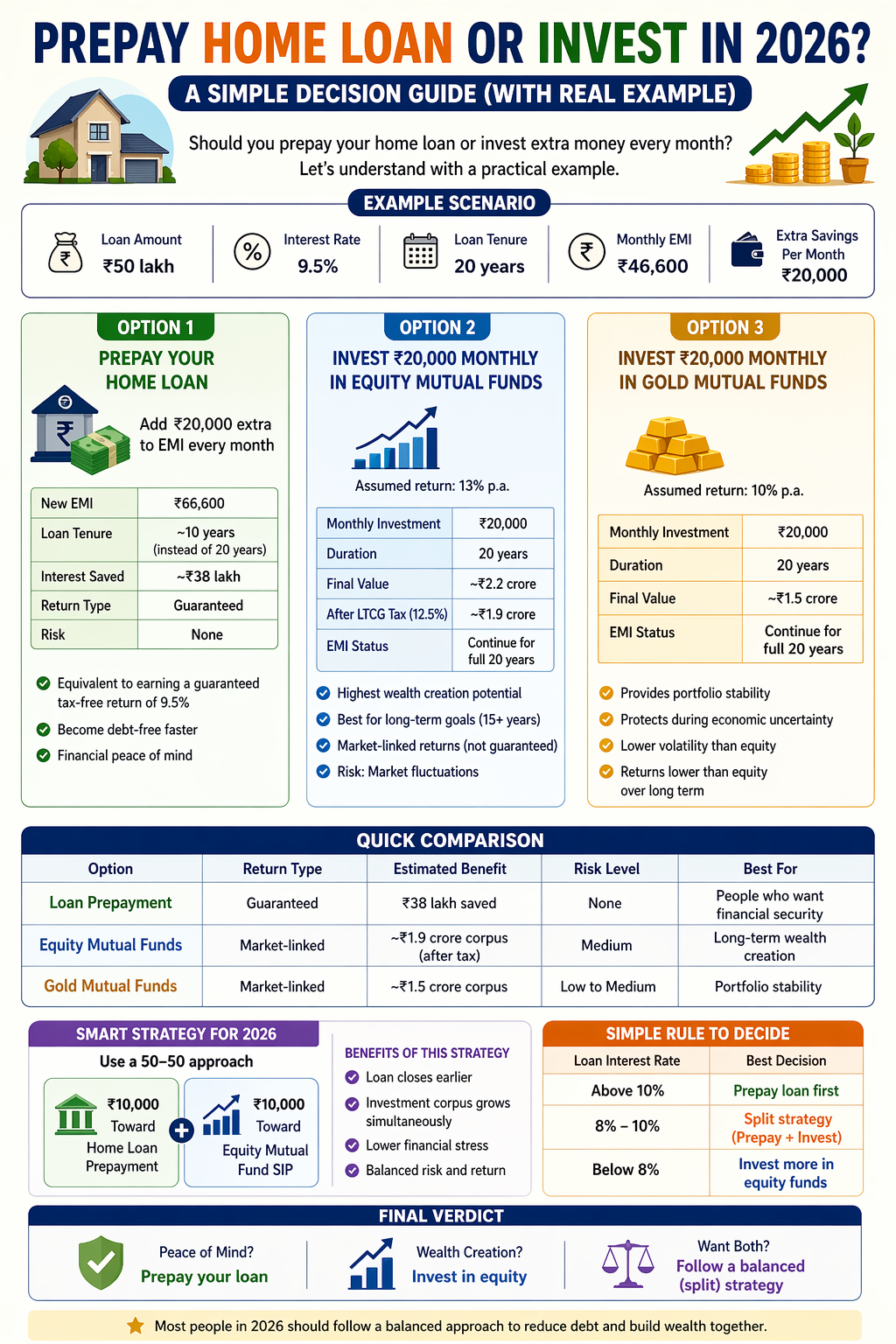
The Smart Strategy for 2026: The "Balanced Approach"
Instead of an "all or nothing" choice, the most practical strategy for most Indian households in 2026 is a split strategy.
For example, split your ₹20,000 extra savings:
- ₹10,000: Towards home loan prepayment.
- ₹10,000: Towards an Equity Mutual Fund SIP.
Why This Balanced Strategy Works
- Hybrid Benefits: You close your loan earlier than scheduled and build an investment corpus at the same time.
- Reduced Stress: You're actively reducing debt while also planning for the future.
- Optimized Returns: You get a balance of a guaranteed return and the potential for higher market returns.
The Simple Rule to Help You Decide
Here's a quick rule of thumb to guide your decision based on your interest rate:
- If Loan Interest is > 10%: Prioritize loan prepayment. The guaranteed return is hard to beat.
- If Loan Interest is 8-10%: A split strategy is typically the most effective and balanced choice.
- If Loan Interest is < 8%: Investing in equity mutual funds is often the best path for long-term wealth creation.
The Final Verdict
The "right" answer comes down to your priorities:
- Choose Prepayment if your primary goal is the peace of mind that comes with being debt-free.
- Choose Equity Investing if your primary goal is maximizing wealth creation.
- Choose a Split Strategy if you want the best of both worlds: financial stability and long-term growth.
In the current financial landscape of 2026, a balanced approach stands out as the most sensible strategy for achieving true financial wellness.